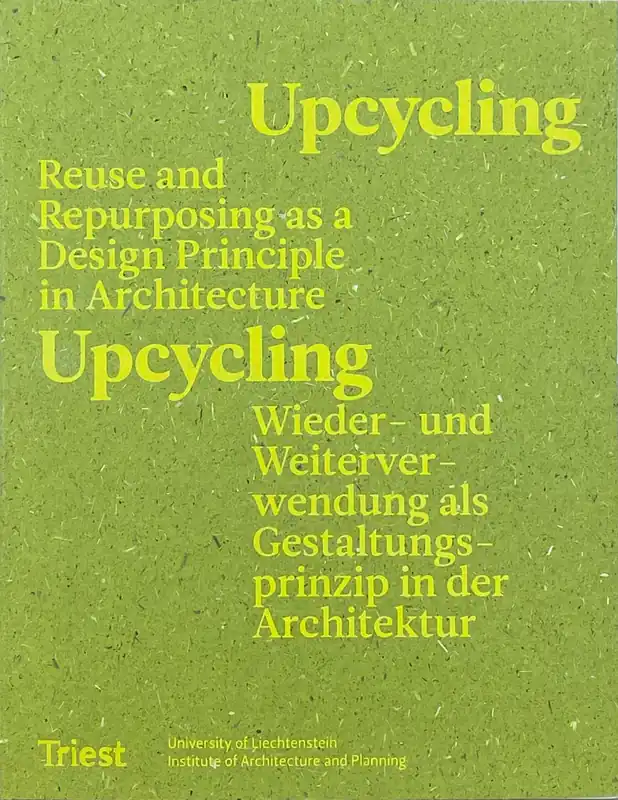

Exploitation and destruction of the environment call for an inevitable paradigm shift as regards our resource consumption: &linnovative&r building will have to break away from the dogma of new build. We need to reconsider the existing building stock as a wealth of resources and ideas, just as we should understand recycling and upcycling building stock as architectonic potential.
New approaches in architecture reveal a trend towards concepts of the frequently used but theoretically and historically rarely defined term upcycling. In that context, one often forgets that the history of building has also always been a history of, firstly, recycled and upcycled building materials and components, and secondly, of building knowledge and building styles. Comprehending buildings as a part of a social change process poses a challenge to our current habits and modern concept of unambiguity, seclusion and authorship of architecture.
This publication explores the potential of historical concepts of upcycling – the qualitative recycling of buildings and building components – and confronts them with new developments in architectural and building practice. Importantly, the authors look into the question of whether and how new solutions could be found for future architecture. &lRecycling and upcycling&r should not be a matter of idealism, but rather present an argument for economy and the quality of structure and design.
With contributions by: Alberto Alessi, Barbara Buser, Jürg Conzett, Elisabeth Crettaz-Stürzel, Anja Diener, Philipp Entner, Hanna Kuzniatsova, Silke Langenberg, Hans Rudolf Meier, Lisa Ochsenbein, Johannes Rederer, Nicholas Ransome, Fetanete Rashiti and Daniel Stockhammer
A new, 3rd edition of this book is scheduled for early 2025
![Koop Online El Croquis 136/137. Work Systems [2]](https://www.novelscrip.com/wp-content/uploads/2026/SK0000006-NL20260521-142559-0-1779344761-9788488386465_300.webp)