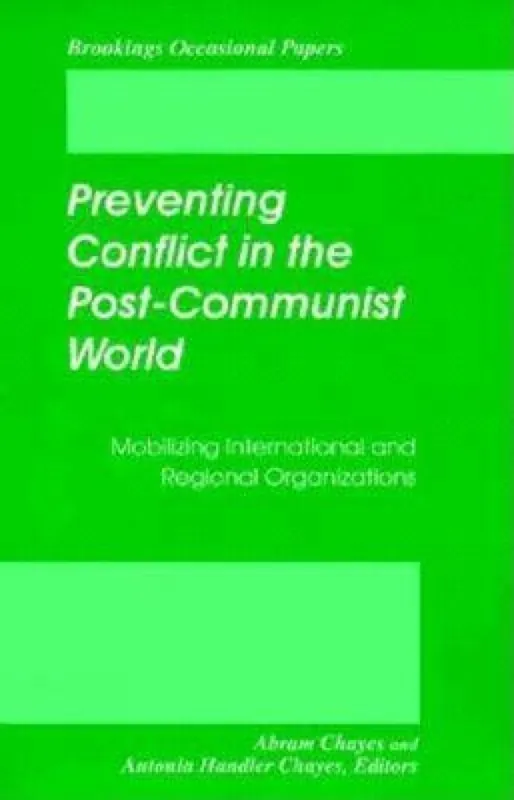

Titel: Preventing Conflict In The Post-Communist World
Schrijver: Abram Chayes
Bindingswijze: Paperback
EAN: 9780815713852
Conditie: Redelijk
Staat van dit boek
Elk boek is handmatig gecontroleerd. Vragen? Stuur gerust een bericht.
Condities
Als nieuw Zo goed als nieuw, geen tot vrijwel geen gebruikssporen.
Goed Lichte gebruikssporen mogelijk, meestal geen aantekeningen.
Redelijk Zichtbaar gebruikt, kan sporen of aantekeningen bevatten.
Nieuw Ongelezen en in nieuwe staat.
Beschrijving:
Western politicians, pundits, and the public were wholly unprepared for the violent conflicts erupting in eastern and central Europe and the former Soviet Union after the end of the Cold War. The governments emerging from communism lack both the authoritarian control to suppress domestic differences and the democratic power to manage them. Old conflicts resurfaced and new ones were kindled in virulent form from Bosnia to Chechnya. The stability of governments and the status quo of borders have been thrown into question. Actual and threatened disintegration of states in the area is widespread. No reference points have emerged to replace the cold war paradigm. Nor is there a way of knowing which conflicts can be contained within accepted borders and which may spill over. The prospect not only of widening conflict, but also of new precedents challenging old certainties of international life, causes deep concern in western Europe and the United States. Europe has many experienced international organizations under whose umbrella states organize to achieve common purposes. This book asks how they have performed that function. How are these organizations attempting to deal with the many forms of internal conflict that are both the cause and the result of the end of communism and the East-West confrontation? Despite significant organizational and financial resources, the results have been meager. The authors show how difficult it is to achieve effective joint action on a sustained basis. They contend that a concerted effort to discover how to achieve joint action is the necessary next step in mobilizing international organizations for preventing ethno-national conflict. In addition to the editors, the contributors are Diana Chigas, Jarat Chopra, Michael W. Doyle, Keitha Sapsin Fine, David S. Huntington, Christophe Kamp, Jean E. Manas, Elizabeth McClintock, John Pinder, Wolfgang H. Reinicke, Reinhardt Rummel, Melanie H. Stein, Shashi Tharoor, Thomas G. Weiss, Richard Weitz, and Mario Zucconi. A Brookings Occasional Paper