
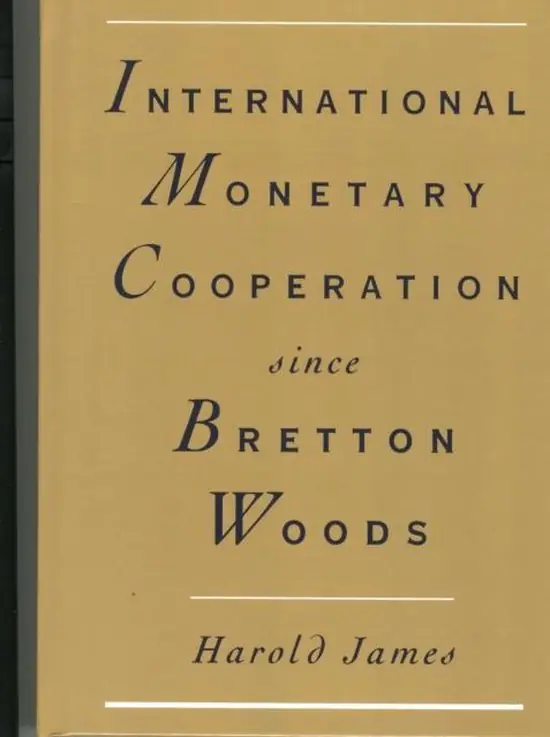

Titel: International Monetary Cooperation Since Bretton Woods
Schrijver: Harold James
Bindingswijze: Paperback
EAN: 9780195104486
Conditie: Goed
Staat van dit boek
Elk boek is handmatig gecontroleerd. Vragen? Stuur gerust een bericht.
Condities
Als nieuw Zo goed als nieuw, geen tot vrijwel geen gebruikssporen.
Goed Lichte gebruikssporen mogelijk, meestal geen aantekeningen.
Redelijk Zichtbaar gebruikt, kan sporen of aantekeningen bevatten.
Nieuw Ongelezen en in nieuwe staat.
Beschrijving:
This comprehensive account of the management of the international monetary system from the 1944 Bretton Woods conference to the present day documents the structure and movements of the world economy during a period of dramatic change.
This comprehensive account of the management of the international monetary system from the 1944 Bretton Woods conference to the present day documents the structure and movements of the world economy during a period of dramatic change. Commissioned by the International Monetary Fund to mark its fiftieth anniversary, the work is nevertheless a fully independent one: written by an outside historian with full access to IMF archives and staff, and reviewed by an independent editorial committee. An objective study of issues and events that are often controversial, the book skillfully interweaves the history of the IMF with that of world economic developments after the Second World War.
The International Monetary Fund was created at Bretton Woods, but almost immediately the rivalry between the Soviet Union and the West split the industrialized world into two economic camps. As a result the IMF’s role underwent significant changes in the immediate post-war years. Harold James analyzes the system during a period of relative stability until 1971, when the United States abandoned fixed exchange rates. Since that time countries have experienced radical fluctuations in the values of their currencies and the IMF has contended with the consequences.
James brings to this history a unique breadth of knowledge and mastery of both economic theory and archival sources. In a well-paced and smoothly flowing narrative, key themes emerge, including the IMF’s increasing surveillance role in global capital markets and its responsivenes in ensuring international monetary stability. Recent political changes make it possible to bring to light the Fund’s work promoting liberalization in planned economies. James also reveals how intellectual changes have led to increasing consensus in the world about what constitutes good economic policy. The gold standard and the dollar standard, he concludes, have been replaced by a new “information standard” under which acccurate economic information is crucial to continuing properity.
A story of continuity as well as change, International Monetary Cooperation Since Bretton Woods offers enduring lessons about international economic coordination. It will be of strong interest to all those concerned with the future, as well as the past, of the world economy.