
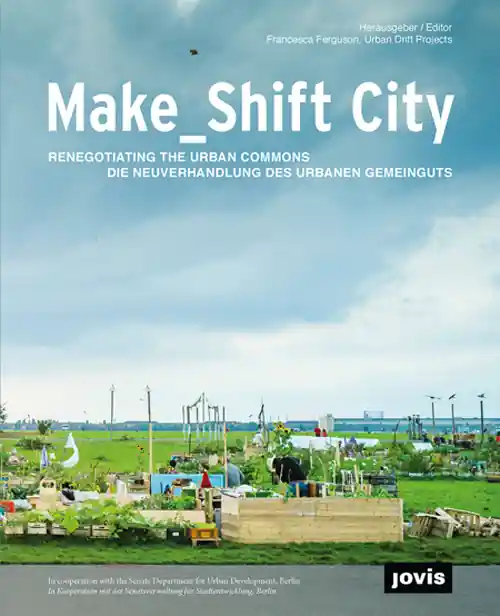

The book Make_shift City. Renegotiating the Urban Commonslooks at urban design strategies that renegotiate and emancipate shared spaces and resources within the city, showing how the increasing scarcity of resources and commons – particularly in Western cities – have far-reaching consequences for the everyday urban experience.
Makeshift implies a temporary or expedient substitute for something else, something missing. Make-Shift City extends the term to embrace urban design strategies. &lMake-Shift City&r implies a condition of insecurity: the inconstant, the imperfect and the indeterminate. It also implies the designing act of shifting or reinterpretation as a form of urban détournement.
Austerity urbanism and the increasing scarcity of resources among the cities and boroughs of Europe in particular has far-reaching consequences for civic space. Where there is a lack of regular planning processes, gaps arise as open spaces that enable an ad-hoc informal urban design. What often results is a process of urban commoning: the renegotiation of shared spaces and shared resources.