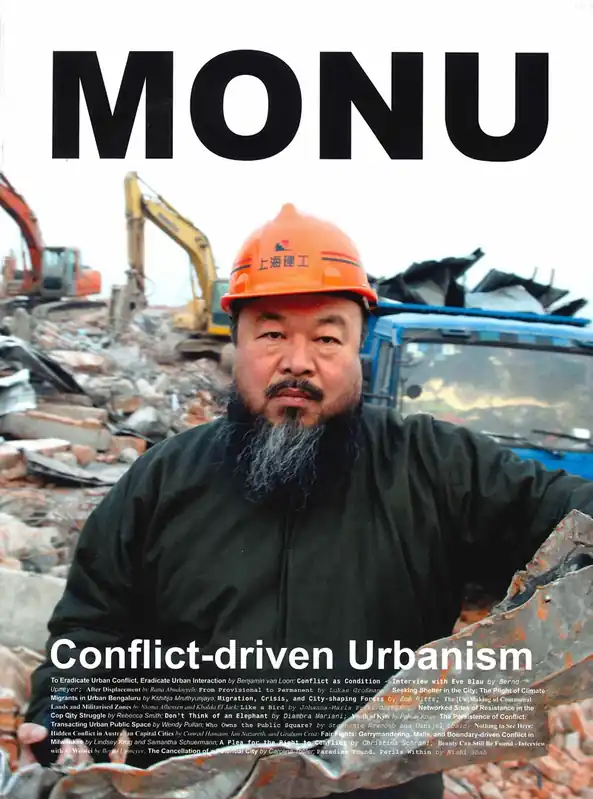

To Eradicate Urban Conflict, Eradicate Urban Interactionby Benjamin van Loon;Conflict as Condition – Interview with Eve Blauby Bernd Upmeyer;After Displacementby Rana Abudayyeh;From Provisional to Permanentby Lukas Großmann;Seeking Shelter in the City: The Plight of Climate Migrants in Urban Bengaluruby Kshitija Mruthyunjaya;Migration, Crisis, and City-shaping Forcesby Zoë Ritts;The [Un]Making of Communal Lands and Militarised Zonesby Niema Alhessen and Khalda El Jack;Like a Birdby Johanna-Maria Fritz/OSTKREUZ;Networked Sites of Resistance in the Cop City Struggleby Rebecca Smith;Don’t Think of an Elephantby Diambra Mariani;Youth of Kyivby Fabian Ritter;The Persistence of Conflict: Transacting Urban Public Spaceby Wendy Pullan;Who Owns the Public Square?by Stephanie Newcomb and Danijel Losic;Nothing to See Here: Hidden Conflict in Australian Capital Citiesby Conrad Hamann, Ian Nazareth, and Graham Crist;Fair Fights: Gerrymandering, Malls, and Boundary-driven Conflict in Milwaukeeby Lindsey Krug and Samantha Schuermann;A Plea for the Right to Conflictby Christina Schraml;Beauty Can Still Be Found – Interview with Ai Weiweiby Bernd Upmeyer;The Cancellation of a Potential Cityby Carolina Tobler;Paradise Found, Perils Withinby Nishi Shah
&lTo Eradicate Urban Conflict, Eradicate Urban Interaction&rasBenjamin van Loonstates in his satirical article that is structured as a memo to the members of a fictitious association: the North American Alliance for Gated Communities. Because urbanism is inherently conflict-driven asEve Blaupoints out in our interview with her entitled&lConflict as Condition&r. According to her, processes of urbanization involve a certain amount of violence and destruction as cities are places of power, representation, and contestation, which she thinks is both positive and negative. How negative it may become is demonstrated byRana Abudayyehin her contribution&lAfter Displacement: Conflict-driven Urbanism and the Shaping of the Syrian Refugee Narrative&rin which she shows how the onset of the Syrian Refugee Crisis in 2011 marked one of the largest conflict-driven exoduses in modern times. She elucidates in what way refugees engage in the reconstruction of their urban environments through&lConflict-driven Urbanism&r, concurrently reshaping their places and identities while navigating the complex structures of belonging in the form of translocational placemaking. Through this,&lConflict-driven Urbanism&rcan become a catalyst for empowerment, enabling transient communities to assert agency in temporal settings and unstable conditions. But not everyone can escape conflict, either due to financial restraints or by choice, not wishing to abandon their lands, and thus typically are left to fend for themselves asNiema AlhessenandKhalda El Jackargue in their piece&lThe [Un]Making of Communal Lands and Militarised Zones: Conflict-driven Urbanism in Al-Shajara, Khartoum&r. How the inhabitants that are left behind nevertheless manage to create self- help practices is revealed in the article. One of the most effective strategies involves the construction of so-called &lemergency response rooms&r that have become lifelines for the hundreds who have remained, transforming public and private buildings such as schools and homes into communal kitchens and aid-centres tapping efficiently into the resources necessary to sustain and create this new layer of&lConflict-driven Urbanism&rwithin these Sudanese neighbourhoods. Some of its practices shine as lights and symbols of hope in conflicted regions, illustrating an alternative life like the one thatJohanna-Maria Fritz/OSTKREUZoffers in her photo-essay&lLike a Bird&r, in which she presents circus cultures in countries known for troubled politics and dire living conditions such as Iran, Afghanistan, or Palestine. A similar optimism is tangible in the images ofFabian Ritterthat portray how the&lYouth of Kyiv&ris returning to the Ukrainian capital engaging once again in theater rehearsals, organizing flea markets, reuniting at the lake, and joining concerts. However, in many conflicted regions solutions are elusive and we may simply have to learn how to live with certain levels of conflict, accepting it as the price paid for diversity, asWendy Pullanargues in&lThe Persistence of Conflict: Transacting Urban Public Space&r. But for her a city is only a city when it encompasses diversity, indicating that cities are both robust and delicate at the same time. Therefore, if we wish to address the problem of conflict in cities, we must recognise and play to the strengths of both these qualities and according to her public space is one of the key ways to make this happen. Unless you aim for remoteness and dispersal, both at a global scale and an urban scale: a tactic to avoid conflict, or render it invisible, asConrad Hamann,Ian Nazareth, andGraham Cristsuggest in&lNothing to See Here: Hidden Conflict in Australian Capital Cities&rreferring to sprawl and emptiness as a chief tool of protection, which comes probably closest to the earlier mentioned anti-urbanism approach to conflict ofvan Loon. However, as a lack of conflict, illustrated as the Australian Dream byHamann,Nazareth, andCrist, can easily camouflage a machinery of inequality and environmental depletion, with which affordability and sustainability are kept at a distance, a complete absence of conflict appears to be never entirely positive either. Thus,Christina Schramlargues in her contribution&lA Plea for the Right to Conflict&rthat conflicts should not be viewed merely as disruptive but as essential and inevitable in society, playing a crucial role in preserving democracy. The goal should not be conflict elimination but fostering methods that sustain conflict as a productive state, transforming and re-imagining spaces as more dynamic environments that embrace conflicts as an integral part of urban coexistence. Conclusively, under most circumstances, conflicts cannot be definitively classified as either destructive or constructive, asAi Weiweiwraps it up in the second interview entitled&lBeauty Can Still Be Found&remphasizing that, as a human being, the greatest challenge lies in addressing the spiritual state of individuals within these conflicts. The goal should not be to become a casualty of conflict, but to treat other lives and living environments in a humane and benevolent manner. Consequently,Nishi Shahurges in&lParadise Found, Perils Within&rthat architects, urban and spatial planners – often dismissive of war-torn territories – must exhibit unparalleled adequacy in addressing spaces of conflict as the initial step towards reimagining an architecture for peace.