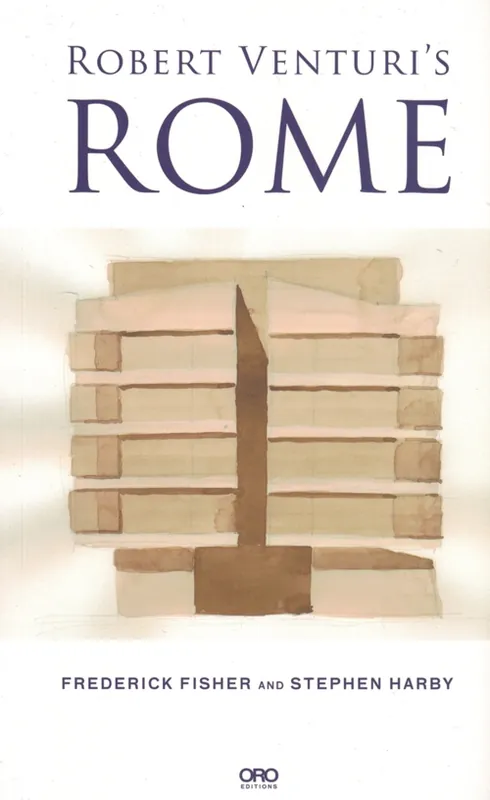

Robert Venturi’s Romeis a guidebook to the city of Rome as seen through the eyes of Robert Venturi and his classic textComplexity and Contradictionin Architectureby two subsequent Rome Prize fellows and architects, Frederick Fisher and Stephen Harby. Fisher and Harby take the reader on a journey back through time by visiting and discussing the Roman buildings and places that exemplify Venturi’s revolutionary ideas. The buildings and what they meant toVenturi are re-examined with the perspective of fifty years ofarchitectural advancements. The volume is full of imaginative and analytical watercolor illustrations painted exclusively for the book and inspired by the small black and white illustrations in Venturi’s work.
In the original book, published in 1966, Venturi viewedarchitecture, landscape and art as different manifestationsof common aesthetic themes. Venturi wrote this seminal publication following a two-year Rome Prize fellowship at theAmerican Academy in Rome, and there is no doubt the cityhad a profound influence on his thinking. Many buildings inRome serve as examples that illustrate his theories. From thePantheon, through works by his favorite artist, Michelangelo,and on to 20th century buildings by Armando Brasini and LuigiMoretti, Venturi reveals Rome as a complex and contradictorycity.Complexity and Contradiction in Architecturebecame oneof the era’s most significant theoretical works on architecturaltheory and is still fundamental to the development of every young architect’s outlook on architecture. Thus, Fisher and Harby’sRobert Venturi’s Romepays homage to the designinfluence this publication has had, and will continue to have, onthe design world.